Draft: from 52 to 87 — measuring whether agents can use an API
Draft launch post with example data from a fictional API. How a generated MCP server scored 52, what four overlay changes and code mode did, and why the number matters.
Turning an OpenAPI spec into an MCP server takes a minute now. The question we kept hearing afterwards was simpler and harder: do agents actually succeed with it? This post walks through how Neurouter answers that, using the demo's fictional API.
The starting point: 46 operations, one score
The Acme Orders API has 46 operations. Imported as is, Neurouter compiles 46 tools, with names like getOrdersV2 and a legacyExportOrders that still looks useful. Before any eval, the spec lint gives a preliminary score.
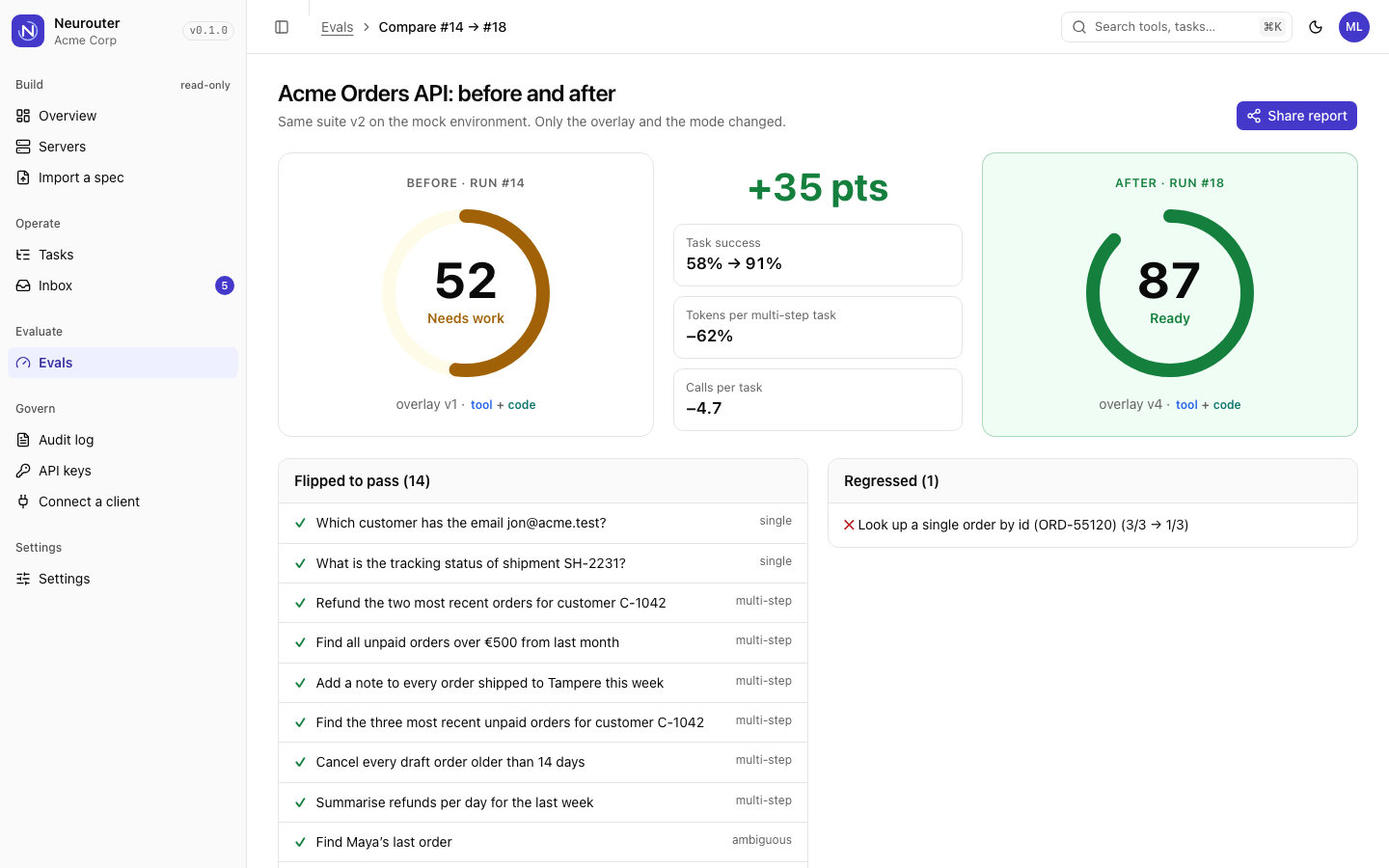
Then we ran an eval: tasks generated from the spec, including multi-step tasks and a few the API can't do, run three times each against a mock of the API. Run #14, raw spec, tool mode: 52, Needs work.
What failed, and why
Grouping the failures by cause pointed at four problems. Three of the fixes below are the kind Neurouter proposes; hiding the legacy tool was a manual overlay edit:
| Cause | Tool | Proposed overlay change |
|---|---|---|
| Wrong tool | getOrdersV2 | Rename to list_orders |
| Wrong tool (9 tasks) | search_customers vs list_customers | Rewrite the description to contrast the two |
| Wrong tool (7 times) | legacyExportOrders | Hide it (an overlay change we made by hand) |
| Bad arguments (11 failures) | create_refund | Add an example: the amount is in minor units |
A fifth group was different: on five impossible tasks, agents tried to refund several orders at once. That's not a description problem; it's a missing capability, and it matched the most-reported unmet need in the ops inbox.
Verify, apply, re-run
Each suggestion was verified on the affected tasks before it was applied to the overlay draft, then published. Runs #15 to #17 climbed. Run #18 added code mode, where the agent writes one short Python script instead of a chain of calls. Run #18: 87, Ready.
What the number is for
A score is only useful if it moves for the right reasons. That's why it's built from checks on what agents actually called, why it's reported per model and per mode, and why it can gate a pull request: if a spec change makes the API harder for agents, CI should say so before users do.
Run the same before/after on your own API with npx neurouter eval (v0.1.1).